
Back From the Future: From Science Fiction to Historical Fiction
From Arthur C. Clarke judge to editor-at-large with an historical fiction publisher

How did an editor and writer who began learning his craft on a semi-professional science fiction journal come to be editor-at-large with an historical fiction publisher?
This question led me to thinking about the appeal of both genres, science fiction and historical fiction, what they might have in common, and how one might go from one to the other. It also resulted in a realisation. That just as in 1974 I stopped living in Hampshire and began living in Dorset while not going anywhere (the government moved the county boundary), so what was once, when I was young, the provenance of near-future science fiction is now the domain of historical fiction. All it took was time.
When I was born, NASA was developing the Apollo program, but going to the moon was science fiction, which is to say it hadn’t happened yet, and no one knew if it ever would. The first manned landing wouldn’t take place for another seven years.
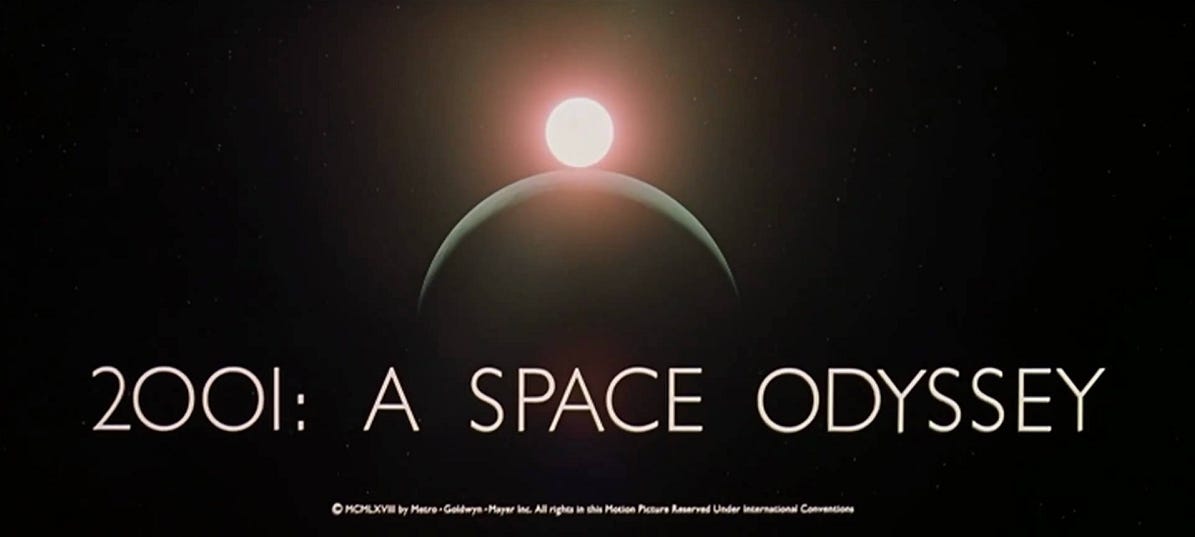
The film 2001: A Space Odyssey (1968), which included the most realistic depiction of people on the moon to that date, was released the year before the first manned landing. It proved to be the most successful film of its year and, when I finally saw it in 1970, it became a major influence on my tastes. Of course it did; I was an imaginative eight-year-old boy who had made his parents promise to wake him up in the middle of the night so that he could watch the moon landing live on TV. With the confidence of youth, I decided that 2001 was the best film ever made (my aunt, who I had talked into taking me to see it, had wanted to leave after twenty minutes. I refused to budge, so she had no choice but to endure the entire film).
In the 70s, I tried to find other films as great as 2001: A Space Odyssey – a film which, perhaps not incidentally, covers a span of history from ‘The Dawn of Man’ to the then-near future and ‘Beyond the Infinite’ – eventually concluding there weren’t any. I also read a lot of science fiction, including novels and stories by Arthur C. Clarke, who with director Stanley Kubrick co-wrote the screenplay for 2001. Eventually this would lead to my volunteering to feature edit Vector: The Critical Journal of the British Science Fiction Association (a position I shared with Andrew M. Butler, the two of us being the only volunteers, so we were given the job jointly as neither of us had any previous editorial experience), and a few years later being asked to join the judging panel of the Arthur C. Clarke Award. (Andrew is now Chair of Judges of the Clarke Award.) Volunteer for things — you never know where it might lead.
I was a Clarke judge in the real 2001 (from 1999 to 2001), and interviewed Sir Arthur himself. (You can read the transcript on my website). Much to my astonishment, largely I think as a result of Sir Arthur learning that my father had been in the RAF throughout WWII, just as he had been himself, we even ended up being regular email correspondents for a few years, until his health declined to the point where his computer use was necessarily restricted to essentials. My interview with Sir Arthur was by phone, a satellite link from England to Sri Lanka, a once science-fictional technology he had predicted in a famous article in Wireless World (October 1945, ‘Extra-Terrestrial Relays: Can Rocket Stations Give World-wide Radio Coverage’).
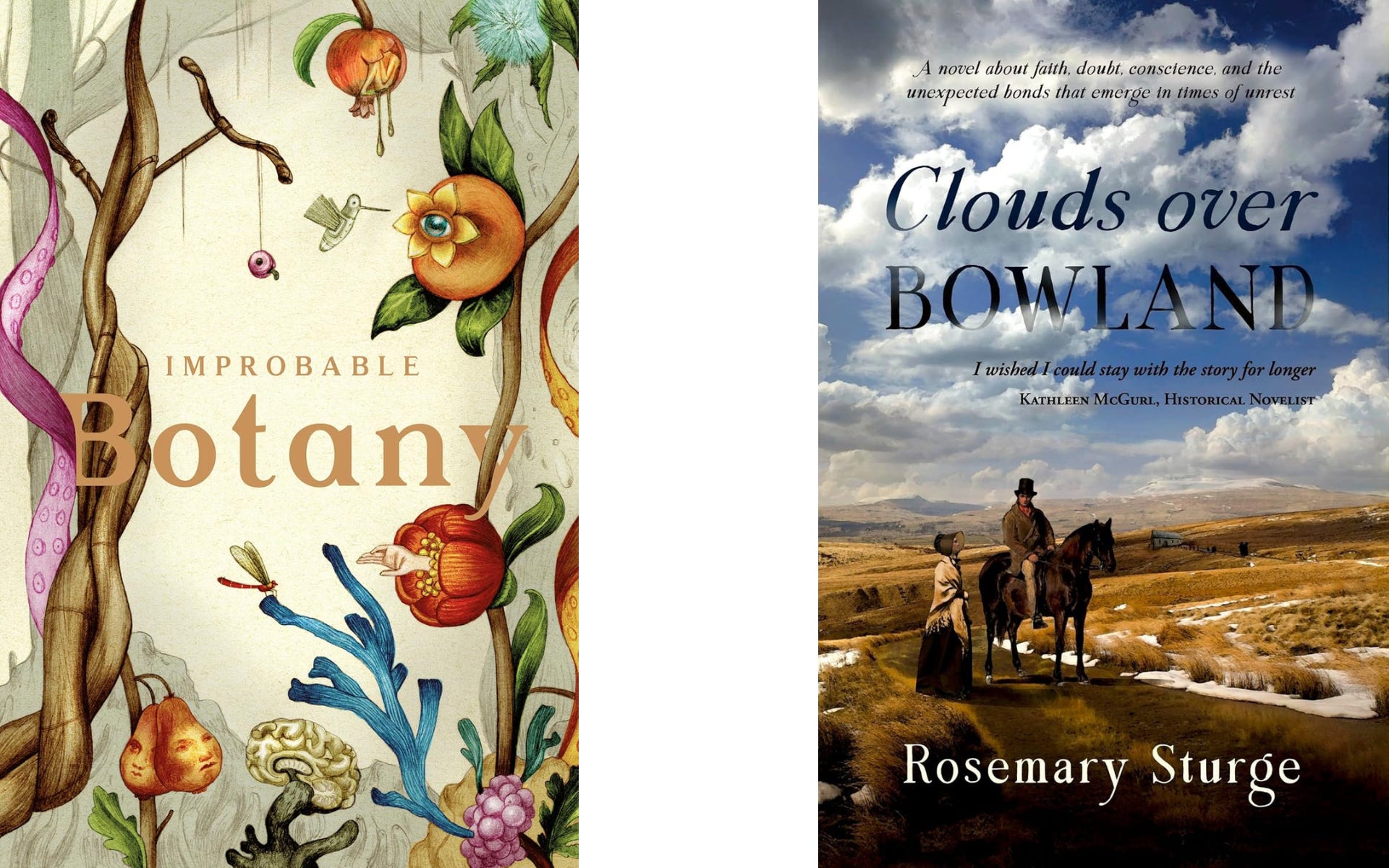
And that’s a brief introduction to my background in science fiction — I also wrote for numerous magazines and websites, including Interzone, Matrix, DeathRay, Shoreline of Infinity and Amazing Stories. A highlight as an editor was commissioning and editing the stories for the anthology Improbable Botany, featuring awarding winning authors from both sides of the Atlantic, including Ken MacLeod, Adam Roberts, Justina Robson and Tricia Sullivan.
I never read or watched science fiction exclusively, though, but always whatever interested me, which right up to the present has included the full spectrum of speculative fiction – fantasy and horror as well as SF – plus thrillers, crime, historical adventures, and as I got older ‘literary fiction’, as well as a wide range of non-fiction. As the years have gone by, I have read less science fiction and more historical fiction, as well as increasing numbers of volumes of biography and history. And if you ask me now what my favourite films are, I’ll tell you 2001: A Space Odyssey, the Russian War and Peace (1965-67), Inception (2010), and William Shakespeare’s Hamlet (1996), an even split between science fiction and historical fiction. What do they have in common? They are all brilliantly made, utterly absorbing, and deal with big themes on the grandest of scales.
Though I have edited quite a lot of historical fiction, I hadn’t particularly thought about how it is defined, but when Cadence Publishing director Sophie Beal decided to focus on historical fiction and launched the Cadence Timepiece imprint, it occurred to us that we should be clear about what we meant by the genre. It was then that I found that it is generally accepted that historical fiction is fiction set at least 50 years before it was written. This does seem unsettlingly recent; the long hot summer of 76, which I remember well, now fits into the genre.
Still, it’s all a matter of perspective, the passage of time and what is sufficiently ‘old’ to belong to history. Around the beginning of this millennium I told a friend’s young son – he was about eight – that I saw Star Wars on opening day, and he looked at me with a mixture of incredulity (as if I might be testing his gullibility), wonder (that I wasn’t utterly decrepit), and awe (as if I was some wise old jedi knight fallen to earth from a more civilised age, a long time ago in a galaxy far, far away). It’s all relative.
The Walter Scott Prize settles on 60 years as the earliest historical fiction can be set from the time it is written, while the Historical Writers’ Association says historical fiction shall be defined as being ‘beyond 35 years from the point of application’, which includes the fall of the Berlin Wall, so early last year.
All of which brings me to the point that the moon landing, which so captured my imagination as a young boy, is now firmly in the domain of both history and historical fiction. As indeed is 2001: A Space Odyssey. A novel written about the Apollo program, or about the making of 2001, would be historical fiction. The two intersect, in that Arthur C. Clarke provided television commentary for the Apollo program. He could be a character in either hypothetical novel.
So in one sense you could say that I haven’t changed; that it is the world that has switched genre while I was busy getting older. I do though, in general, now find historical fiction more appealing than science fiction. This is partly because the future looks far less attractive than it once did – climate change, environmental and food chain collapse; famines, mass migrations, genocides, pandemics, endless wars – but then who needs the future when the present feels like we are living in a Philip K. Dick novel? A present where a tech entrepreneur who controls one of the world’s most powerful communication networks is building spaceships to go to Mars and has just become the world’s first trillionaire. Where, in the wake of a global pandemic, people laugh at the idea of vaccines, believe the world is flat, and that no one ever went to the moon (which is sort of where we came in). But whereas in 2001 we had an early mainstream demonstration of the AI alignment problem (the HAL 9000 computer decides a mission will go better without the human crew of the spaceship Discovery, so sets about killing them), now AI is a potentially real existential threat, and people are ‘marrying’ chatbots.
I do miss the old millennium, all of 27 years ago, when, the world seemed more sane, the most extreme, conspiratorial and hateful voices maintaining a much lower profile. Before 9/11 - the 25th anniversary of which is rapidly approaching - since when so much has changed for the worse. By contrast with the late 20th century, the present often feels exhausting, too absurd to want to think about for long; the future, even more so. The past, by contrast, more easily casts an illusion of comprehensibility, of manageability, for being more contained.
When I started thinking about writing this post, I wondered how the two genres, science fiction and historical fiction, mirrored each other, which may on the surface seem a strange idea, but both have at heart imaginative constructions of other times, other worlds, that we can never truly know.
We can extrapolate from current trends what the future might be like, but the only way to find out for sure is to go there, one day at a time, as I have been doing from before the moon landings. As you have been doing since whenever you were born.
Similarly, if we live a sufficiently long time, we come to remember events that have slipped into the realm of historical fiction, but while we can go to the future a day at a time, we can never directly revisit the past. We can, though, read about it, explore archives, watch history documentaries, explore historic and ancient sites, talk to older people whose memories go back many decades. There are ways to reconstruct the past, just as there are means to conceptualise potential futures, but doing so will always be an imaginative exercise. Just like science fiction, historical fiction will forever be a reflection of the concerns of the era in which it is written.
When Stephen King wrote the dystopian science fiction novel The Running Man (1982) he set it in 2025 because that seemed then, to him as a relatively young man, unimaginably far off, or so he said in interviews he gave when a new film adaptation of the novel was released last year. And some aspects of the story rang startlingly true (not that the prime directive of SF should ever be mere anticipation), from increasingly dangerous sport as mass media distraction – the president of the USA just held a celebratory evening of cage fighting outside the White House – to hijacking and flying a plane into a skyscraper (something the new film hadn’t the nerve to visualise).
But equally, historical fiction often looks to the past and tells us something about our present. And by some lights, a novel set in the year The Running Man was written would now be historical fiction.
Authors and readers choose those aspects of the past (or future) to write and read about based on what resonates with them. As authoritarianism is resurgent around the world, it’s no surprise there is a boom in historical fiction set in WW11, with a very significant subgenre telling stories of resistance and the Holocaust. I should know — I’ve edited some of these novels myself, including Mark deMeza’s international bestseller, The Thirteenth Child and its follow-up, The Heroine of Auschwitz, as well as Rachel Evans’ Dark is the Night, and its yet-to-be-published sequel.
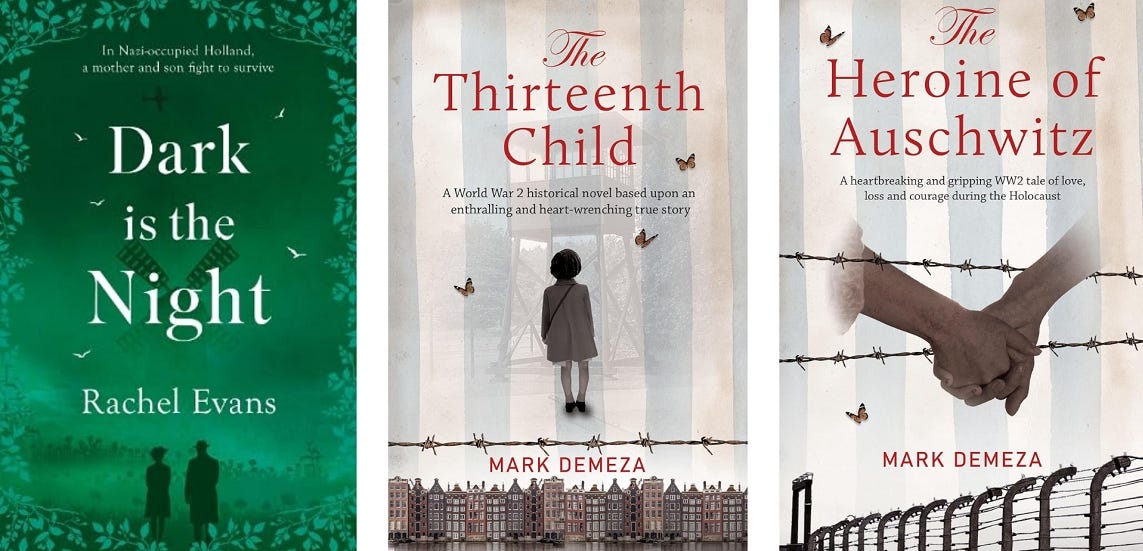
I also share editorial duties with Sophie Beal on Cadence Publishing’s historical novels, the first of which was the recently published Clouds Over Bowland by Rosemary Sturge, and what interests me most now is finding excellent historical fiction, stories of the past, which will resonate with readers of today.
In the end, time will leave us all behind, turning us into history in some future we can’t quite imagine, but for now there are endlessly rich possibilities to explore in editing and publishing great new stories about what might have been.
Gary Dalkin is Editor-at-large for Cadence Publishing. With Cadence Publishing director Sophie Beal he sometimes gives the popular talk Organising Chaos: Turn a Messy Draft Into a Publishable Novel. You can find out much more about Gary at tothelastword.com and even hire him to edit your book. You can also follow him here on Substack: To The Last Word - Gary Dalkin.
*
All posts on Timepieces represent the views of the author only.
 | A guest post by
|
There's definitely overlap, as you say both genres exist to reflect our contemporary world. I also find it harder to imagine the extremes of Sci-fi now we're living in such a technological world.